
In Google Search Console, Average Position is one of the most misunderstood performance metrics. Many website owners assume it reflects a fixed ranking number, but in reality, it represents an average across multiple impressions, queries, and search sessions.
A page may show an average position of 8.3, but that does not mean it consistently ranks at position 8. Instead, it reflects how Google displayed the page across different searches.
Understanding how Average Position works is essential for interpreting SEO performance correctly. This guide explains what it means, how it is calculated, why it fluctuates, and how to use it properly for optimization decisions.
What is Average Position?
Average Position in Google Search Console represents the average ranking position of a URL across all impressions during a selected time period.
It is calculated based on the highest ranking position of your page for each impression.
For example:
If your page appears:
- Position 5 for one search
- Position 10 for another search
The average position becomes:
(5 + 10) ÷ 2 = 7.5
This means your page does not rank consistently at 7.5, it ranks at different positions depending on the query and context.
Average Position is not a fixed rank. It is a calculated mean.
How Google Search Console Calculates Average Position
Google Search Console tracks impressions and records the highest ranking position your page achieved for each search query.
If your page ranks:
- Position 3 for Query A
- Position 7 for Query B
- Position 15 for Query C
The system averages those values across all impressions. Since Average Position is calculated based on impressions, it is important to understand how impressions are counted in Google Search Console.
Important points:
- Position is calculated per impression.
- If a page appears multiple times for one query, the highest position is counted.
- The final metric is averaged across all impressions.
This is why Average Position can look misleading when impression volume is low.
For example:
1 impression at position 1
1 impression at position 20
Average = 10.5
But that does not reflect stable ranking.
Why Average Position Fluctuates
Fluctuation in Average Position is normal. It changes because:
1. Different Queries
Your page may rank differently for various keywords.
For example, it may rank:
- Position 4 for one variation
- Position 12 for another
The average shifts accordingly.
2. Device Differences
Rankings may differ on:
- Mobile
- Desktop
Google Search Console averages across device types unless filtered.
3. Location Variations
Search results can vary by geography.
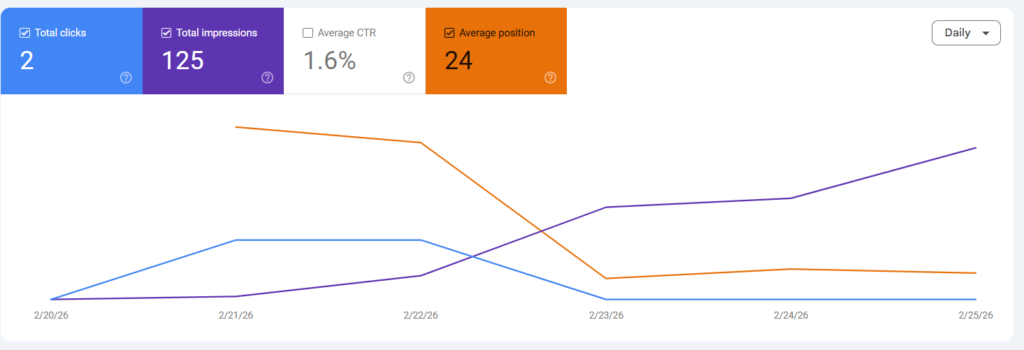
4. Low Impression Volume
On new domains, small data sets distort averages significantly.
If you only have 10 impressions, a single ranking jump can drastically change the average.
What is a Good Average Position?
There is no universal “good” number.
However, general guidance:
- 1–3 → Strong first-page visibility
- 4–10 → First-page but competitive
- 11–20 → Second-page range
- 20+ → Low visibility
But Average Position alone does not measure performance. It should always be analyzed alongside CTR (Click-Through Rate) to understand how ranking translates into actual traffic.
You must analyze it together with:
- Impressions
- Clicks
- CTR
For example:
Position 3 with low CTR may indicate title issues.
Position 15 with rising impressions may indicate growth potential.
Average Position without context is incomplete.
Why Average Position can be misleading
Many assume that a position of 8 means stable ranking at 8.
In reality:
- You may rank 2 for some queries
- Rank 18 for others
- Rank 7 occasionally
The average blends all of this.
It hides volatility.
For new websites, Average Position can look unstable during early growth phases. As impressions increase, ranking data becomes more reliable.
Average Position should be interpreted as a trend indicator, not a precise ranking guarantee.
How to Use Average Position Strategically
Instead of obsessing over single-day changes, use it for:
1. Trend Analysis
Track whether the average improves over weeks, not days.
2. Query-Level Optimization
In Google Search Console:
Go to: Performance → Queries
Identify keywords where you rank between:
Positions 8–15
These are optimization opportunities.
Small improvements in content or title can push them to page one.
3. Diagnose CTR Issues
If Average Position is strong but CTR is low, the issue may be title alignment.
If Position is weak but CTR is decent, ranking is the main constraint.
Average Position must be analyzed together with CTR for meaningful insights.
Average Position vs Real-Time Rank Tracking
Google Search Console provides averaged historical data.
It is not:
- A live rank tracker
- A personalized ranking monitor
Third-party tools may show different numbers because they simulate specific location or device searches.
Search Console reflects aggregated user data across real impressions.
That makes it more realistic, but also more generalized.
Why Average Position Matters for New Websites
On newly launched domains, Average Position helps measure visibility growth.
You may initially rank in positions 30–50. Over time, as content stabilizes, the average improves.
Even a movement from 28 to 19 indicates progress.
Tracking these shifts weekly helps understand search momentum.
However, short-term fluctuations are normal. Focus on directional movement rather than daily noise.
Average Position in Google Search Console reflects how your page ranks across multiple searches, queries, and impressions over time. It is an averaged performance indicator, not a single ranking number.
When analyzed correctly, alongside impressions, clicks, and CTR, it provides valuable insight into search visibility trends and optimization opportunities.
Rather than reacting to daily changes, focus on long-term movement and contextual performance analysis. Used strategically, Average Position becomes a diagnostic metric that supports structured SEO growth. This article is part of our broader SEO Foundations series focused on measurable search performance analysis.
What does average position mean in Google Search Console?
Average Position represents the average ranking of a page across all impressions within a selected date range.
Why is my average position changing daily?
Rankings vary by query, device, and location. Low impression volume can also cause visible fluctuations.
Is average position accurate?
It is accurate as an averaged metric, but it does not represent a fixed ranking position.
What is a good average position?
Positions between 1 and 10 indicate first-page visibility, but performance must be evaluated alongside impressions and CTR.