In SEO, impressions and clicks are often discussed separately. However, the metric that connects them is CTR (Click-Through Rate). While impressions measure visibility and clicks measure traffic, CTR measures performance efficiency.
CTR tells you how effectively your search result converts visibility into visits. A page may appear thousands of times in search results, but if users don’t click, that visibility has limited value.
Understanding what CTR is, how it is calculated, and how it influences search performance is essential for diagnosing SEO issues and improving organic traffic. This guide explains CTR clearly, including its formula, benchmarks, and optimization strategies.
To understand how CTR connects impressions and clicks, see our breakdown of the difference between impressions and clicks in SEO.
What is CTR in SEO?
CTR (Click-Through Rate) in SEO is the percentage of users who click on your search result after seeing it in Google search results.
It measures how often users choose your page when it appears in the search engine results page (SERP).
CTR Formula
CTR is calculated using a simple formula:
CTR = (Clicks ÷ Impressions) × 100
For example:
If your page receives:
- 10 clicks
- 100 impressions
CTR = (10 ÷ 100) × 100 = 10%
This means 10% of users who saw your result decided to click on it.
CTR does not measure rankings directly. It measures user response to your listing.
How CTR is Calculated in Google Search Console
Google Search Console automatically calculates CTR using the clicks and impressions recorded for each page or query. If you need a detailed explanation of how impressions are counted, read our guide on Google Search Console impressions meaning.
- Impressions are counted each time your page appears in search results.
- Clicks are counted when a user selects your result and visits your page.
- CTR is displayed as a percentage.
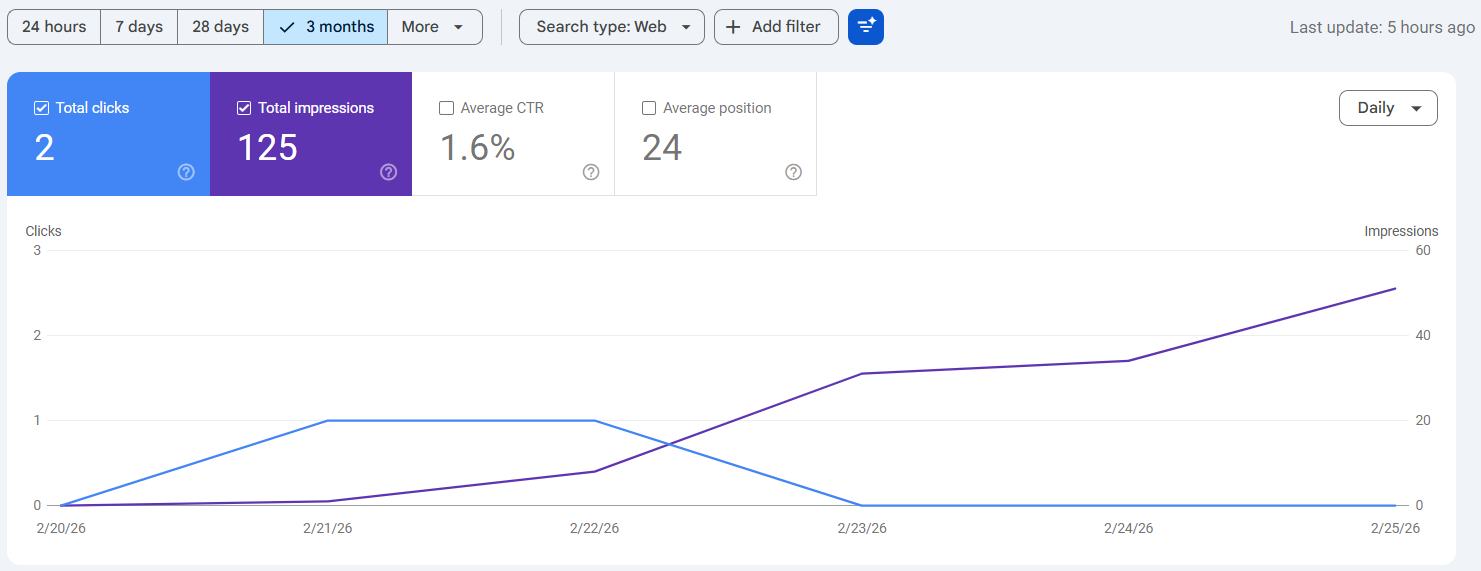
In Google Search Console, CTR can be analyzed at multiple levels:
- Page level
- Query level
- Device level
- Country level
It’s important to understand that small datasets can distort CTR. For example, if a page receives:
1 click and 1 impression → CTR = 100%
But this does not mean the page performs exceptionally well. It simply means the data volume is too small to draw conclusions.
On new domains, CTR may fluctuate significantly in early stages due to low impression counts. As impressions increase, CTR stabilizes.
What is a Good CTR in SEO?
A “good” CTR depends heavily on ranking position and search intent. However, general benchmarks based on organic search behavior are:
- Position 1 → 25–35% CTR
- Position 2 → 15–20% CTR
- Position 3 → 10–15% CTR
- Positions 4–10 → 3–10% CTR
- Page 2 → 1–5% CTR
These are average estimates. Actual CTR varies depending on:
- Industry
- Keyword competitiveness
- Brand recognition
- SERP features (ads, featured snippets, AI overviews)
- Search intent
For example, informational queries may have lower CTR if Google displays detailed answers directly in search results.
CTR should always be evaluated relative to ranking position. A 6% CTR at position 2 may indicate a weak title. A 6% CTR at position 8 may actually be strong performance.
Does CTR Affect Rankings?
CTR is one of the most debated topics in SEO.
Google does not officially confirm CTR as a direct ranking factor. However, CTR reflects how relevant and appealing your result is to users.
If a page consistently attracts clicks relative to its ranking position, it may signal strong alignment with user intent. Conversely, consistently low CTR may indicate:
- Weak title tags
- Poor meta descriptions
- Misaligned content intent
- Strong competitor listings
While CTR alone does not guarantee ranking improvements, it often correlates with better performance when supported by strong content and relevance. CTR should always be evaluated alongside average position in Google Search Console to understand whether low clicks are caused by weak rankings or weak messaging.
CTR should be treated as a performance diagnostic metric rather than a guaranteed ranking lever.
Why CTR is Important for New Websites
For newly launched domains, impressions often increase before stable traffic begins. A page may start appearing in search results without immediately generating consistent clicks.
Monitoring CTR during this stage helps identify:
- Whether titles are compelling
- Whether content matches search intent
- Whether ranking position limits visibility
If impressions rise but CTR remains very low, the issue may be messaging rather than ranking.
On small sites, early CTR fluctuations are normal. As impressions grow and ranking positions stabilize, CTR becomes a more reliable indicator of performance.
For structured SEO growth, CTR acts as a bridge between visibility (impressions) and engagement (clicks).
How to Improve Organic CTR
Improving CTR does not always require increasing impressions. Often, small adjustments can significantly improve performance.
1. Rewrite Title Tags
Titles should be:
- Clear
- Specific
- Intent-aligned
- Benefit-driven
Avoid vague titles like “SEO Guide.”
Use structured clarity such as “Complete SEO Guide for Beginners (Step-by-Step).”
2. Improve Meta Descriptions
While meta descriptions are not ranking factors, they influence user decisions.
A clear, concise description that matches search intent improves click probability.
3. Match Search Intent
Analyze top-ranking pages for your keyword. If your content does not align with user expectations, CTR will suffer.
4. Use Structured Data
Adding FAQ schema or Article schema can enhance SERP appearance and potentially improve click behavior.
5. Reduce Unclear Definition
Users click when they understand what they will get. Specificity increases trust and clarity.
Small CTR improvements can generate noticeable traffic increases without changing rankings.
CTR in SEO measures how effectively your search visibility converts into traffic. It connects impressions and clicks into a single performance metric that reveals user engagement.
While CTR is not officially confirmed as a direct ranking factor, it plays a critical role in diagnosing search performance issues. A page with high impressions but low CTR may require title optimization or intent alignment. A page with strong CTR indicates effective messaging and relevance. This article is part of our broader SEO Foundations series focused on measurable search performance.
For structured SEO growth, CTR should be analyzed alongside impressions, clicks, and ranking position. Together, these metrics provide a clearer understanding of search performance and optimization opportunities.
What does CTR mean in SEO?
CTR (Click-Through Rate) in SEO measures the percentage of users who click on your search result after seeing it in search results.
How is CTR calculated?
CTR is calculated by dividing clicks by impressions and multiplying the result by 100.
What is a good CTR for organic search?
A good CTR depends on ranking position, but position one typically receives between 25–35% CTR, with percentages decreasing for lower positions.
Does improving CTR increase rankings?
Improving CTR alone does not guarantee ranking increases, but it often reflects better alignment with search intent and stronger result appeal.