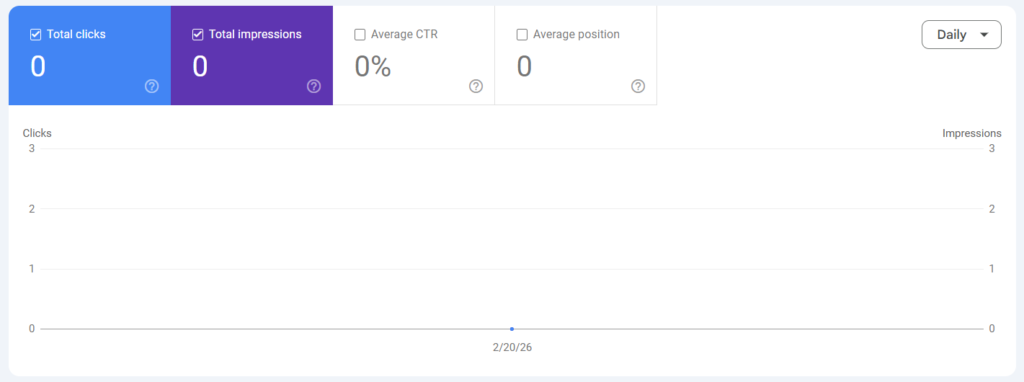
If you have recently started using Google Search Console, you’ve probably noticed the “Impressions” metric in the Performance report. Many website owners get confused when they see impressions increasing but clicks remaining low or even at zero.
So what exactly does an impression mean in Google Search Console?
In simple terms, an impression is counted every time your webpage appears in Google’s search results for a user’s query, whether or not the user clicks on it. This article explains what impressions actually represent, how Google counts them, and how you can use impression data strategically to improve your SEO performance.
What are Impressions in Google Search Console?
In Google Search Console, an impression is recorded when your website URL appears on a search engine results page (SERP) for a query.
It does not require a click.
If your page is shown anywhere in the organic results for a search query, that counts as one impression.
Important clarifications:
- The user does not need to click your result.
- The user does not even need to scroll down to your result.
- If your page appears on page 2 of Google, it still counts as an impression.
- If your page appears in a rich result (such as a featured snippet), it counts as an impression.
In short, impressions measure visibility, not traffic.
As documented in our baseline SEO metrics analysis, early impression growth often appears before traffic increases.
How Google Counts an Impression
Google counts an impression whenever your page is loaded as part of a search results page.
Here’s how it works in different situations:
1. Standard Organic Results
If your page ranks in position 18 for a query and appears on page 2 of the search results, that is still counted as an impression when someone performs that search.
Even if the user never clicks page 2, Google still registers it as an impression because your URL was technically shown.
2. Featured Snippets and SERP Features
If your page appears in:
- Featured snippets
- Image packs
- FAQ rich results
- Other SERP features
It still counts as an impression.
3. Multiple Appearances
If your page appears more than once for a single query (rare but possible), Google still counts it as one impression per search.
For example:
If 100 users search a keyword and your page appears for all 100 searches, that equals 100 impressions, even if no one clicks.
Impressions vs Clicks vs CTR vs Average Position
Understanding impressions alone is not enough. You need to interpret them alongside other metrics.
Here’s how they relate:
| Metric | Meaning |
|---|---|
| Impression | Your page appeared in search results |
| Click | A user clicked your result |
| CTR (Click-Through Rate) | Clicks divided by impressions |
| Average Position | The average ranking position of your page |
How They Work Together
- High impressions + low clicks = visibility but weak engagement.
- High impressions + high CTR = strong ranking and compelling title/meta.
- Low impressions = limited visibility (possibly low rankings or low search demand).
Impressions tell you that Google is showing your page. CTR tells you whether users find it appealing.
Why You See Impressions But No Clicks
This is one of the most common questions in SEO.
You may see impressions increasing while clicks remain zero or very low. Here’s why:
1. Low Ranking Position
If your page ranks in position 15, 20, or lower, it may appear in search results but receive very few clicks. Most users click results on page 1.
2. Weak Title Tag
Your page might be visible, but if the title is unclear or unappealing, users won’t click.
3. Poor Meta Description
Even though meta descriptions don’t directly impact rankings, they influence CTR. A weak description can reduce clicks significantly.
4. Strong Competition
If the top results are authoritative brands, users may prefer those options even if your page appears.
5. Search Intent Mismatch
If your content doesn’t match user intent, impressions may occur without clicks.
Seeing impressions without clicks is not a failure. It’s a signal and signals are useful in SEO.
Why Impressions Matter for SEO Strategy
Many beginners underestimate impressions because they focus only on traffic.
But impressions are one of the earliest indicators of SEO progress.
Here’s why they matter:
1. Visibility Growth Indicator
If impressions are increasing week over week, it means your page is appearing for more searches or improving in ranking.
Even without clicks, rising impressions indicate movement.
2. Early Ranking Signal
Before traffic increases, impressions often rise first. This means Google is testing your page in search results.
3. Keyword Discovery Tool
By filtering queries in Search Console, you can see which keywords are generating impressions, even if you didn’t intentionally target them.
This helps you:
- Identify new content ideas
- Optimize for related terms
- Improve internal linking
4. Optimization Opportunity
A sudden increase in impressions with low CTR often indicates ranking near page 1 or page 2.
This is the perfect time to:
- Improve your title tag
- Rewrite your meta description
- Strengthen internal links
Impressions reveal opportunities before traffic fully arrives.
Future optimization experiments will focus on improving CTR and ranking signals.
How to Improve Impressions in Google Search Console
If you want to increase impressions, focus on increasing your search visibility.
Here are practical steps:
1. Publish Targeted Content
Create content around specific keywords with clear search intent.
2. Improve Internal Linking
Internal links help Google understand your site structure and distribute authority.
3. Optimize Title Tags
Clear, keyword-focused, and compelling titles improve both impressions and CTR.
4. Target Long-Tail Keywords
Long-tail keywords are easier to rank for, especially on newer domains.
5. Update Existing Content
Refreshing older posts can improve rankings and increase impressions over time.
Impressions grow when your rankings improve or when your content appears for more relevant queries.
Impressions alone do not determine search performance. The percentage of users who click after seeing your result is measured through CTR (Click-Through Rate).
Common Misunderstandings About Impressions
Let’s clear up a few misconceptions:
- Impressions do not equal traffic.
- High impressions do not automatically mean success.
- Low impressions don’t always mean poor content, sometimes it means low search demand.
- CTR often matters more than raw impression numbers.
Impressions are a visibility metric, not a performance metric by themselves.
Google Search Console impressions measure how often your page appears in search results. They do not indicate traffic, but they provide valuable insight into search visibility and ranking behavior. Visibility through impressions does not guarantee traffic. Your average position in Google Search Console determines where your result appears in search results.
If impressions are rising, it means Google is showing your content more frequently. If impressions are high but clicks are low, it signals an opportunity for optimization.
Instead of ignoring impressions, use them strategically. They are often the first sign that your SEO efforts are beginning to work.
Frequently Asked Questions:
What counts as an impression in Google Search Console?
An impression in Google Search Console is recorded each time a webpage appears in Google search results for a user’s query. It is counted even if the user does not scroll to the result or click on it.
Why do I have impressions but no clicks?
Impressions without clicks typically occur when a page ranks lower in search results or has a weak title and meta description. The page is visible in search results, but users are not choosing to click it.
Do impressions mean my website is ranking on page one?
Impressions do not necessarily mean a page is ranking on the first page of Google. A webpage can generate impressions while ranking on page two or lower, as long as it appears in the search results.
Are impressions important for SEO performance?
Impressions are important for SEO because they indicate search visibility and keyword coverage. Rising impressions often signal improving rankings or expanding query reach, even before traffic increases.